


Ingredient Guide
CoQ10: The Compound Your Cells Use to Make Energy
- Evidence-based
- Structure/function only
- No proprietary blends
What it is
How it works
Why the form & source matter
How Monthlees uses it
Frequently asked questions
What is CoQ10?
A compound your cells make (also called ubiquinone) that helps produce cellular energy and acts as an antioxidant.
Ubiquinone or ubiquinol?
Ubiquinone is the conventional, most-studied form; ubiquinol is the reduced form. Some studies find ubiquinol is absorbed better, others find the finished formulation matters more than the form. Both are fat-soluble.
Should I take it with food?
Yes — it's fat-soluble, so a meal with some fat improves absorption.
Why supplement it?
The body makes CoQ10, but natural levels tend to decline with age.
Research & references
-
Understanding coenzyme Q — Physiological Reviews (2024) (source)
CoQ is an electron transporter in the mitochondrial ETC central to cellular redox balance and antioxidant defenses. -
Coenzyme Q10 Supplementation in Aging and Disease — Frontiers in Physiology (2018) (source)
CoQ10 is essential to mitochondrial bioenergetics and acts as an antioxidant; tissue levels decline with age.
References are provided for general educational context. They do not imply that this product treats, cures, or prevents any disease.
These statements have not been evaluated by the Food and Drug Administration. This product is not intended to diagnose, treat, cure, or prevent any disease.
Free 3-minute assessment. No purchase required.
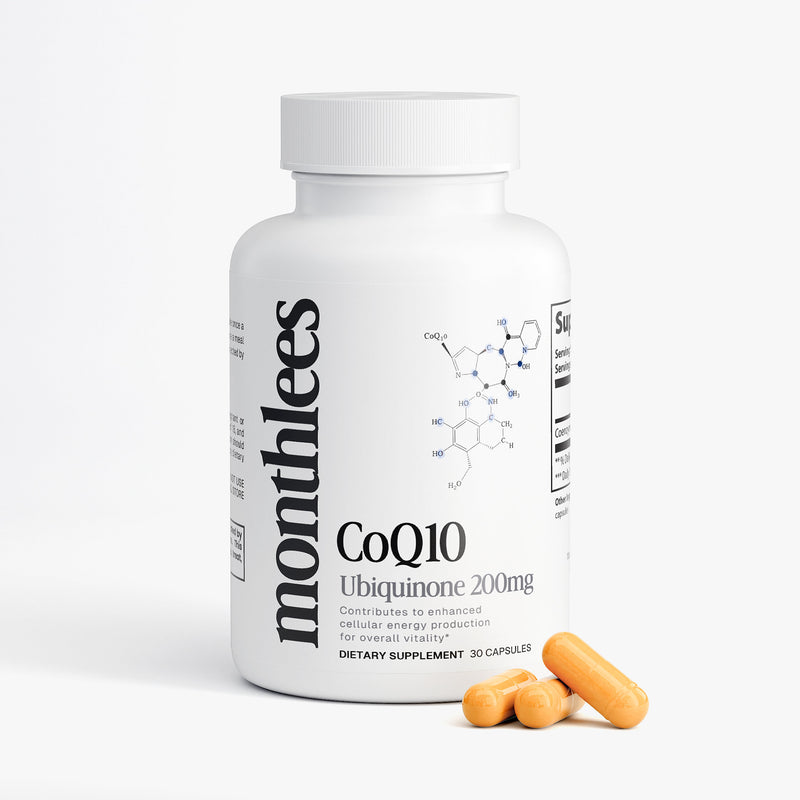
CoQ10 Ubiquinone
200 mg CoQ10 ubiquinone per capsule — mitochondrial energy, heart support, and antioxidant protection.
Monthlees membership
Unlock member pricing on every reorder — cancel anytime.
Join for member pricing →Explore more guides
See how this ingredient fits into broader goals and daily routines.


