


Ingredient Guide
Turmeric and Curcumin: Absorption Is the Real Spec
- Evidence-based
- Structure/function only
- No proprietary blends
What it is
How it works
Why the form & source matter
How Monthlees uses it
Frequently asked questions
What's the difference between turmeric and curcumin?
Curcumin is the antioxidant compound within turmeric; supplements concentrate it well beyond the spice.
Why is black pepper added?
Piperine from black pepper is the common way to address curcumin's poor absorption on its own.
What should I check on a turmeric product?
The absorption approach (often piperine) alongside the curcumin amount.
Capsule or gummy?
Same compound — capsules suit a concentrated daily dose, gummies trade some concentration for ease.
Research & references
-
Bioavailability of curcumin: problems and promises. — Molecular Pharmaceutics (2007) (source)
Documents curcumin's poor bioavailability and absorption-enhancement strategies. -
Curcumin, the active substance of turmeric: its effects on health and ways to improve its bioavailability. — Journal of the Science of Food and Agriculture (2021) (source)
Curcumin is turmeric's active substance; reviews ways to improve bioavailability.
References are provided for general educational context. They do not imply that this product treats, cures, or prevents any disease.
These statements have not been evaluated by the Food and Drug Administration. This product is not intended to diagnose, treat, cure, or prevent any disease.
Free 3-minute assessment. No purchase required.
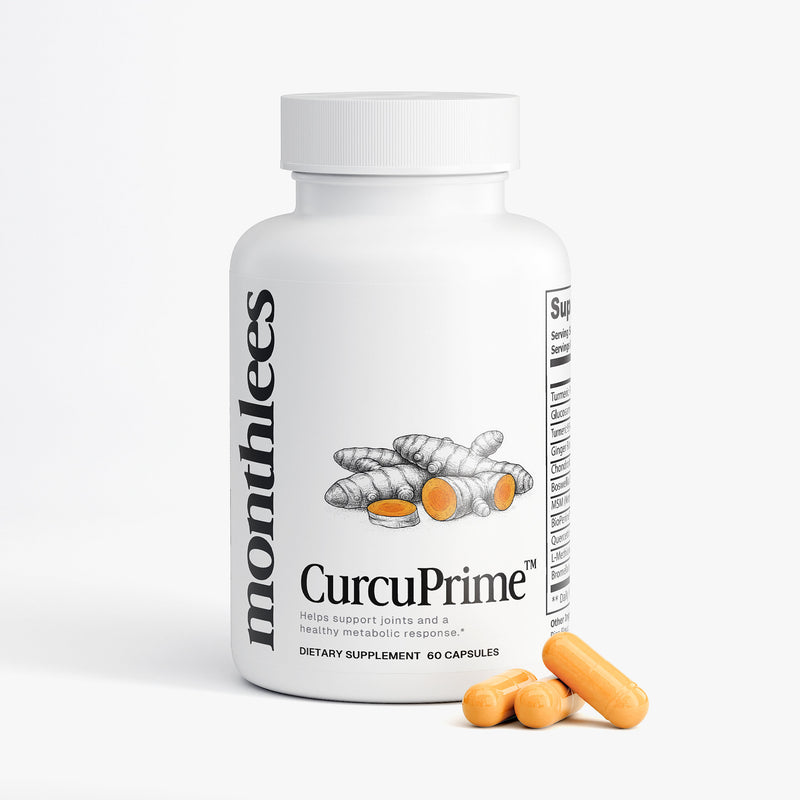
CurcuPrime™
All-in-one joint support — turmeric, glucosamine, Boswellia, and BioPerine® in two daily capsules.

Flex+™ - Advanced Joint Support
Plant-based glucosamine, turmeric, Boswellia, MSM, and hyaluronic acid — advanced joint support in two daily capsules with olive oil.
Monthlees membership
Unlock member pricing on every reorder — cancel anytime.
Join for member pricing →Explore more guides
See how this ingredient fits into broader goals and daily routines.


